


 Object Model

Syntax
| Visual Basic (Declaration) | |
|---|---|
Public MustInherit Class LayerSource | |
| C# | |
|---|---|
public abstract class LayerSource | |
Remarks
Dynamic Layers allow the execution of various ArcGIS Server requests from a client application. An in-depth discussion about Dynamic Layers is in the ArcGISDynamicMapServiceLayer Class documentation. The client side requests that can be issued to ArcGIS Server include the ability to:
- Change the rendering of an existing ArcGISDynamicMapServiceLayer. See the code examples for the ArcGISDynamicMapServiceLayer.LayerDrawingOptions Property, the ArcGISDynamicMapServiceLayer.CreateDynamicLayerInfosFromLayerInfos Method, and the LayerDrawingOptionsCollection Class.
- Create a layer on-the-fly for the Workspace Types of: Database, Shapefile, FileGDB, and Raster. See the code examples in the ArcGISDynamicMapServiceLayer.DynamicLayerInfos Property (for a Database Workspace Type) and the DynamicLayerInfoCollection Class (for a Shapefile Workspace Type).
- Perform table joins.
- Query for specific records. See the code example for the QueryDataSource Class.
- Identify features. See the code example for the Tasks.IdentifyParameters.DynamicLayerInfos Property.
- Return raster images.
Dynamic Layers are new in ArcGIS Server v10.1 and require the ESRI runtime platforms of Silverlight, WPF, or Windows Phone v 3.0 and higher.
Use one of the two inherited LayerSource Classes to utilize a Dynamic Layer:
The following Properties accept the LayerSource object:
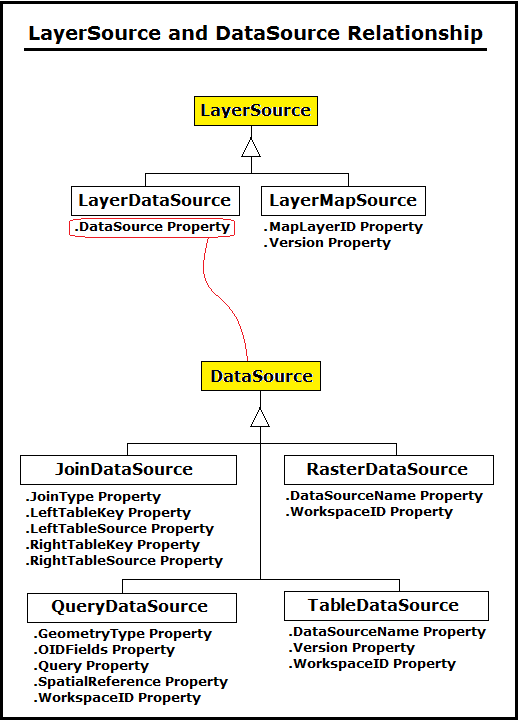
The following image is simplified Object Model Diagram demonstrating the relationship between the LayerSource and DataSource objects in constructing a Dynamic Layer.
Inheritance Hierarchy
System.Object
ESRI.ArcGIS.Client.LayerSource
ESRI.ArcGIS.Client.LayerDataSource
ESRI.ArcGIS.Client.LayerMapSource
Requirements
Target Platforms: Windows XP Professional, Windows Server 2003 family, Windows Vista, Windows Server 2008 family